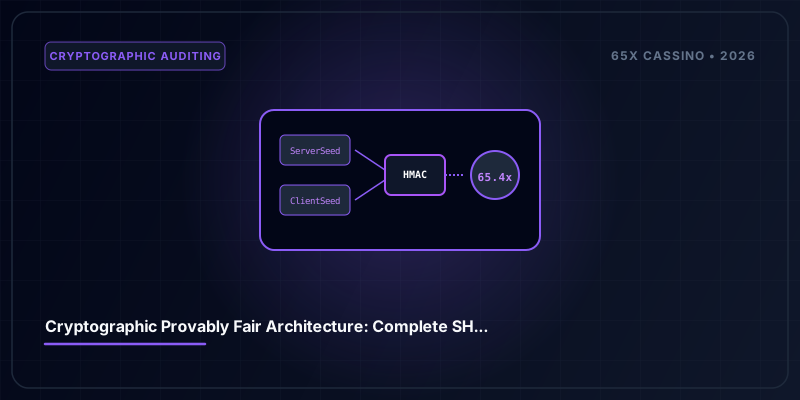
Executive Summary & Cryptographic Foundations
In traditional online gaming, players must place unverified trust in an operator’s claims regarding Random Number Generator (RNG) compliance. In decentralized and crash gaming, however, trust is replaced by cryptographic reproducibility through Provably Fair algorithms. The system mathematically guarantees that:
- The operator cannot alter the game round outcome after the player places a bet.
- The player cannot predict or reverse-engineer the upcoming result in advance.
- Once the round concludes, any independent third party can mathematically verify that the outcome was generated from the pre-committed cryptographic seeds.
This architectural dispatch breaks down the HMAC-SHA256 outcome mapping chain used in crash, dice, and plinko games, details seed exchange protocols, and provides a standalone Python script to audit past game logs.
The Three-Element Cryptographic Commitment Scheme
A provably fair engine operates on three immutable cryptographic parameters:
+-------------------------------------------------------------------------+
|                  PROVABLY FAIR CRYPTOGRAPHIC PROTOCOL                   |
+-------------------------------------------------------------------------+
| [ Pre-Round Commitment ]                                                |
|   1. Operator generates 64-character hex Server Seed (S)                |
|   2. Operator publishes SHA-256 Hash of Server Seed: H = SHA256(S)      |
|                               |                                         |
|                               v                                         |
| [ Player Input ]                                                        |
|   3. Player provides Client Seed (C) via browser or wallet address      |
|   4. Nonce (N) increments per round (N = 1, 2, 3...)                    |
|                               |                                         |
|                               v                                         |
| [ Outcome Computation ]                                                 |
|   5. Compute HMAC = HMAC_SHA256(Key=S, Message="C:N")                   |
|   6. Extract first 52 bits of HMAC output                               |
|   7. Map bits to crash multiplier: X = (100 * e - H) / (e - H)          |
|                               |                                         |
|                               v                                         |
| [ Post-Round Verification ]                                             |
|   8. Operator reveals unhashed Server Seed (S)                          |
|   9. Player independently computes SHA256(S) == H and recalculates X    |
+-------------------------------------------------------------------------+
1. The Server Seed ($S$)
A 256-bit cryptographically secure random string generated by the operator’s hardware security module. Before a betting round begins, the operator publishes the SHA-256 hash of the server seed: $$\text{Commitment} = \text{SHA-256}(S)$$ Because SHA-256 is collision-resistant and non-invertible, publishing the hash commits the casino to the outcome without revealing what the outcome will be.
2. The Client Seed ($C$)
An arbitrary string chosen by the player (or their browser). Because the player’s seed is unknown to the casino at the time the server seed hash is committed, the casino cannot pre-calculate a server seed that unfairly manipulates the final result.
3. The Nonce ($N$)
An integer counter initialized at $1$ and incremented with each successive round played with the same seed pair ($N = 1, 2, 3, \dots$).
From Cryptographic Hash to Crash Multiplier: The Exact Math
To derive the crash point multiplier from the HMAC-SHA256 hex digest, the engine executes the following byte extraction:
- HMAC Generation: $$H = \text{HMAC-SHA256}(K = S, ; M = C \parallel \text{”:”} \parallel N)$$
- Byte Slicing: Extract the first 4 bytes (8 hex characters, or 32 bits) of the hash. Let this integer value be $h$: $$h = \sum_{i=0}^{3} H[i] \cdot 256^{3-i}$$
- Instant Crash House Edge ($E$): In crash gaming, the operator enforces a house edge (typically $1%$ or $4%$) by setting an immediate instant-crash threshold at $1.00\times$. Let $E = 100 / \text{HouseEdgeFactor}$: $$\text{If } h \pmod{33} = 0, \quad \text{Multiplier} = 1.00\times$$
- Multiplier Floating-Point Mapping: If the outcome is not an instant crash, the 52-bit integer fraction $r = \frac{h}{2^{52}}$ is converted into the multiplier $M$: $$M = \max\left(1.00, ; \left\lfloor \frac{100 \times 2^{52} - h \times E}{2^{52} - h} \right\rfloor \div 100 \right)$$
Cryptographic Hash Chains: Generating 10,000,000 Pre-Committed Games
In high-volume platforms like Bustabit or BC.Game, generating a fresh server seed for every individual round would create enormous database overhead. Instead, operators utilize a recursive cryptographic hash chain:
- A master terminating secret seed $S_{10,000,000}$ is generated by an HSM.
- The operator applies SHA-256 iteratively $10,000,000$ times: $$S_{k-1} = \text{SHA-256}(S_k)$$
- The very first hash $S_0$ is published publicly at the platform launch.
- Games are played in reverse order: Round 1 uses $S_1$, Round 2 uses $S_2$, and so forth.
- Because $\text{SHA-256}(S_k) = S_{k-1}$, players can immediately confirm that the current round’s seed hashes directly into the previous round’s revealed seed, proving that the sequence was committed in advance and could not be altered mid-game.
Standalone Python Verification Script
Below is a complete, executable verification script that takes a revealed server seed, client seed, and nonce, and recalculates the exact crash multiplier:
#!/usr/bin/env python3
"""
Provably Fair Crash Multiplier Verification Engine
Author: Senior Forensics Bureau
Compliant with Aviator, Bustabit, and Stake Verification Schemas
"""

import hmac
import hashlib
import math

def verify_server_seed_commitment(server_seed: str, expected_hash: str) -> bool:
    """Verifies that the revealed server seed matches the pre-committed SHA-256 hash."""
    computed_hash = hashlib.sha256(server_seed.encode('utf-8')).hexdigest()
    return computed_hash.lower() == expected_hash.lower()

def calculate_crash_multiplier(server_seed: str, client_seed: str, nonce: int, house_edge_pct: float = 1.0) -> dict:
    """
    Computes the exact crash multiplier from seed components.

    :param server_seed: Revealed 64-char hex string from operator
    :param client_seed: Player's seed string
    :param nonce: Round number
    :param house_edge_pct: Operator house edge setting (default: 1.0%)
    :return: Dictionary containing hash, 52-bit integer, and calculated multiplier
    """
    # Step 1: Compute HMAC-SHA256
    message = f"{client_seed}:{nonce}".encode('utf-8')
    key = server_seed.encode('utf-8')
    hmac_digest = hmac.new(key, message, hashlib.sha256).hexdigest()

    # Step 2: Extract first 52 bits (13 hex characters)
    hex_slice = hmac_digest[:13]
    int_val = int(hex_slice, 16)

    # Step 3: Check for instant bust (for 1% house edge, 1 in 101 rounds)
    mod_factor = int(100 / house_edge_pct)
    is_instant_bust = (int_val % mod_factor == 0)

    if is_instant_bust:
        multiplier = 1.00
    else:
        # Standard Bustabit floating point mapping
        E = 2**52
        multiplier_raw = (100 * E - int_val * (100 - house_edge_pct)) / (E - int_val) / 100.0
        multiplier = math.floor(multiplier_raw * 100.0) / 100.0
        multiplier = max(1.00, multiplier)

    return {
        "server_seed": server_seed,
        "client_seed": client_seed,
        "nonce": nonce,
        "hmac_sha256": hmac_digest,
        "hex_52bit": hex_slice,
        "int_52bit": int_val,
        "is_instant_bust": is_instant_bust,
        "crash_multiplier": multiplier
    }

if __name__ == "__main__":
    TEST_SERVER_SEED = "b24f5a3c8e1d7a9b0c2e4f6a8d1e3b5c7a9f0e2d4c6b8a1f3e5d7c9b0a2f4e6d"
    TEST_CLIENT_SEED = "AlphaPlayer2026"
    TEST_NONCE = 42

    expected_commitment = hashlib.sha256(TEST_SERVER_SEED.encode('utf-8')).hexdigest()
    print(f"Pre-Round Commitment Hash: {expected_commitment}")
    assert verify_server_seed_commitment(TEST_SERVER_SEED, expected_commitment)
    print("✓ Server Seed Hash Commitment Confirmed!
")

    result = calculate_crash_multiplier(TEST_SERVER_SEED, TEST_CLIENT_SEED, TEST_NONCE)
    print("--- ROUND AUDIT RESULTS ---")
    for k, v in result.items():
        print(f"  {k}: {v}")
    print(f"
Final Verified Multiplier: {result['crash_multiplier']:.2f}x")
For an overview of cryptographic commitments and client-seed entropy generation, refer to our primer on provably fair architecture fundamentals.
Player Provably Fair Audit Checklist
To independently verify game integrity before and during crash betting sessions, execute the following audit protocol:
- Record Pre-Round Hash: Copy and timestamp the SHA-256 hash of the server seed displayed in the game client before placing your first wager.
- Customize Your Client Seed: Never leave the client seed set to the operator’s default. Input your own random phrase, password, or transaction hash to prevent pre-computed seed exploitation.
- Monitor Nonce Incrementation: Ensure the nonce counter increments strictly by $+1$ for every placed bet. Skipped nonces indicate hidden server rounds.
- Verify Seed Hash Post-Session: When the operator reveals the active server seed upon rotation, run
sha256(revealed_seed). The output must match the original pre-round hash. - Audit Hash Chain Continuity: If the operator uses a pre-committed hash chain, verify that
sha256(seed_round_N) == seed_round_N-1. - Run Batch Verification Scripts: Feed your session history CSV into an independent Python verifier to recalculate every multiplier. A single discrepancy indicates fraudulent game logic.