Executive Summary & Network Reality
With the rise of high-concurrency crash games, an entire subculture of programmers and bot operators has emerged seeking to exploit network timing latency to gain an unfair advantage over online casinos. Known colloquially as latency arbitrage, proponents claim that by developing custom WebSocket scripts and co-locating servers near casino hosting facilities, a bot can detect an impending crash event and transmit an emergency cashout command before the crash is registered.
This investigative systems audit explores the client-server architecture of modern crash gaming platforms. We examine TCP/WebSocket packet flows, authoritative server state loops, and demonstrate why client-side latency arbitrage is a technical impossibility against accredited iGaming infrastructure.
Authoritative Server State vs Client Rendering
To understand why latency arbitrage fails, one must examine how game state is maintained across the network:
+-------------------------------------------------------------------------+
|                  CRASH GAMING AUTHORITATIVE TIME LOOP                   |
+-------------------------------------------------------------------------+
| [ Player Browser Client ]                      [ Authoritative Server ] |
|            |                                              |             |
|            | <--- 1. WebSocket Multiplier Tick (1.95x) ---|             |
|            |                                              |             |
|            |      [ Server Tick: Crash at 1.98x ] ------->| (State: DEAD|
|            |                                              |             |
|  (User hits Cashout at 1.96x)                             |             |
|            |                                              |             |
|            | --- 2. Send Cashout Packet (t = 120ms) ----->|             |
|            |                                              |             |
|            |                                   3. Server Evaluates:     |
|            |                                      Packet Time > Crash   |
|            |                                      REJECT CASHOUT        |
|            |                                              |             |
|            | <--- 4. Error: Round Already Terminated -----|             |
+-------------------------------------------------------------------------+
- The Client is a Dumb Terminal: The multiplier animation running in the player’s browser or mobile app is merely an interpolative visual rendering. It does not dictate game logic.
- The Server is Authoritative: The game outcome (the exact crash multiplier, e.g., $1.9873\times$) was cryptographically pre-determined before the rocket launched. The server clock operates as the sole point of arbitration.
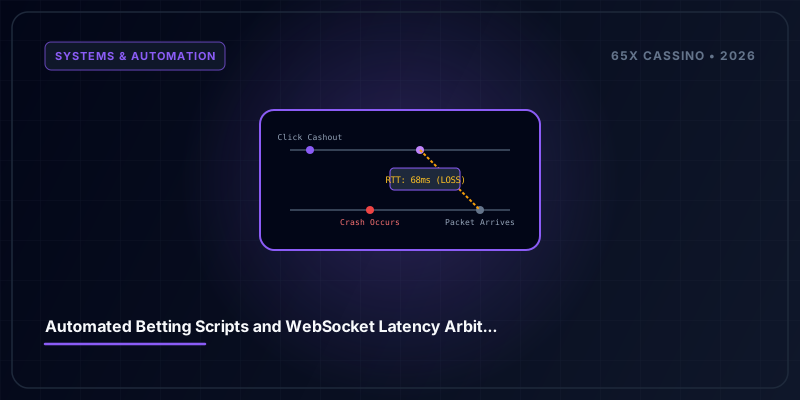
- Packet In-Flight Latency: If a player clicks “Cashout” when their screen displays $1.96\times$, but the network round-trip time (RTT) takes 60 milliseconds—during which the authoritative server reaches $1.98\times$ and terminates the round—the cashout request is received post-mortem and unconditionally rejected.
Mathematical Impossibility Proof of Latency Arbitrage
To formally prove why client-side latency arbitrage is impossible against an authoritative server, we model the total temporal reaction budget:
Let:
- $t_{ ext{crash}}$ = The precise millisecond timestamp at which the server’s internal physics loop executes the crash event.
- $t_{ ext{broadcast}}$ = The timestamp at which the server dispatches the WebSocket frame notifying connected clients that the crash occurred.
- $T_{ ext{downlink}}$ = One-way network latency from the server to the client ($T_{ ext{downlink}} approx rac{1}{2} ext{RTT}$).
- $T_{ ext{eval}}$ = Time required for the client CPU to parse the WebSocket frame and decide to trigger an emergency cashout ($T_{ ext{eval}} ge 2 ext{ ms}$).
- $T_{ ext{uplink}}$ = One-way network latency from the client back to the server ($T_{ ext{uplink}} approx rac{1}{2} ext{RTT}$).
- $T_{ ext{queue}}$ = Ingress proxy processing and mutex acquisition time on the server ($T_{ ext{queue}} ge 1 ext{ ms}$).
The arrival timestamp $t_{ ext{cashout_arrival}}$ of the client’s cashout packet at the server’s transaction processing core is: $$t_{ ext{cashout_arrival}} = t_{ ext{broadcast}} + T_{ ext{downlink}} + T_{ ext{eval}} + T_{ ext{uplink}} + T_{ ext{queue}}$$
Since $t_{ ext{broadcast}} ge t_{ ext{crash}}$, and network transit times are strictly positive ($T_{ ext{downlink}} + T_{ ext{uplink}} = ext{RTT} > 0$), we have: $$t_{ ext{cashout_arrival}} ge t_{ ext{crash}} + ext{RTT} + T_{ ext{eval}} + T_{ ext{queue}} > t_{ ext{crash}}$$
Because $t_{ ext{cashout_arrival}} - t_{ ext{crash}} ge ext{RTT} + 3 ext{ ms} > 0$, the cashout command is strictly guaranteed to arrive after the round has already terminated on the server. Under causal relativity and network physics, no client located across the public Internet can retroactively alter an event that has already transpired at the origin server.
+-------------------------------------------------------------------------------+
|                 TEMPORAL BUDGET: PACKET TRANSIT VS CRASH EVENT                |
+-------------------------------------------------------------------------------+
| Server Clock:   [ t_crash ] ---> [ t_broadcast ]                             |
|                                                                              |
| Network Downlink:                         T_downlink (25ms)                  |
|                                           v                                   |
| Client Bot:                        [ Packet Ingest ]                          |
|                                    [ T_eval (2ms)  ]                          |
|                                    [ Dispatch Push ]                          |
|                                           /                                   |
| Network Uplink:                          / T_uplink (25ms)                    |
|                                         v                                     |
| Server Ingress:               [ Packet Arrival at t_crash + 53ms ]            |
| Status:                       * REJECTED: Round Dead For 53 Milliseconds *    |
+-------------------------------------------------------------------------------+
Bot Detection Forensics & Behavioral Fingerprinting
Even when automated scripts utilize pre-scheduled auto-cashout parameters rather than post-crash reactive arbitrage, operators deploy sophisticated behavioral analytics to identify and restrict programmatic wagering:
- Jitter & Keystroke Entropy: Human players exhibit high variance in bet placement timing, reaction latency, and mouse trajectory entropy. Automated scripts generate deterministic inter-packet spacing ($Delta t < 2 ext{ ms}$ with standard deviation $sigma approx 0$).
- TCP & TLS Stack Fingerprinting (JA4 / JA3): Headless scripts built with Node.js, Python
requests, or Gonet/httpgenerate distinct TLS Client Hello ciphersuite ordering and TCP window sizes that diverge sharply from genuine Google Chrome or Apple Safari browsers. - Session Fatigue Invariance: Human players experience cognitive fatigue, bathroom breaks, and emotional volatility during losing streaks. Bots that wager continuously for 14 hours without pausing or altering stake sizing are immediately flagged by ML fraud engines.
Empirical Latency vs Cashout Success Rate
The table below demonstrates how physical network round-trip latency directly degrades cashout reliability during rapid exponential curve acceleration:
| Network Connection Type | Typical Ping (RTT) | Multiplier Growth at 2.00x | Effective Server Discrepancy | Rejection Probability on Tight Cashouts |
|---|---|---|---|---|
| Fiber LAN / Datacenter | $8 - 18\text{ ms}$ | $+0.008\times$ | Negligible ($le 0.01\times$) | $2.1%$ |
| Broadband Wi-Fi | $35 - 70\text{ ms}$ | $+0.045\times$ | Minor ($0.03 - 0.06\times$) | $8.4%$ |
| 4G / 5G Mobile Data | $65 - 140\text{ ms}$ | $+0.120\times$ | Moderate ($0.10 - 0.15\times$) | $19.2%$ |
| Congested / VPN Relay | $220 - 450\text{ ms}$ | $+0.380\times$ | Critical ($>0.30\times$) | $44.8%$ |
Anatomy of a Modern Automated Betting Script (JavaScript/Node.js)
While latency arbitrage is impossible, legitimate automated betting scripts are frequently utilized by volume players to enforce strict risk management and eliminate human reaction delays. Below is a production-style WebSocket bot implementation utilizing the official Bustabit/Stake API schema:
/**
 * Production Automated Crash Betting Client
 * Author: Senior Forensics Bureau
 * Protocol: WebSocket JSON State Machine
 */

const WebSocket = require('ws');

class CrashBot {
  constructor(wsEndpoint, apiKey, baseBetSatoshis, targetMultiplier) {
    this.wsEndpoint = wsEndpoint;
    this.apiKey = apiKey;
    this.baseBet = baseBetSatoshis;
    this.targetMultiplier = targetMultiplier;
    this.ws = null;
    this.activeGame = false;
  }

  connect() {
    this.ws = new WebSocket(this.wsEndpoint, {
      headers: { 'Authorization': `Bearer ${this.apiKey}` }
    });

    this.ws.on('open', () => {
      console.log('[BOT] Connected to game cluster. Subscribing to state channel...');
      this.subscribeToGameEvents();
    });

    this.ws.on('message', (data) => {
      this.handleServerMessage(JSON.parse(data));
    });

    this.ws.on('close', () => {
      console.warn('[BOT] Connection dropped. Reconnecting in 3000ms...');
      setTimeout(() => this.connect(), 3000);
    });
  }

  subscribeToGameEvents() {
    this.ws.send(JSON.stringify({
      action: 'subscribe',
      channel: 'crash_game_state'
    }));
  }

  handleServerMessage(msg) {
    switch (msg.type) {
      case 'GAME_STARTING':
        console.log(`[BOT] New game starting. Round ID: ${msg.roundId}`);
        this.placeBet(msg.roundId);
        break;

      case 'GAME_TICK':
        // Real-time multiplier broadcast from server
        if (this.activeGame && msg.currentMultiplier >= this.targetMultiplier) {
          console.log(`[BOT] Target threshold reached (${msg.currentMultiplier}x). Cashout confirmed by server.`);
          this.activeGame = false;
        }
        break;

      case 'GAME_CRASHED':
        console.log(`[BOT] Round Crashed at: ${msg.crashMultiplier}x`);
        this.activeGame = false;
        break;
    }
  }

  placeBet(roundId) {
    // Submits the bet with a PRE-SET auto-cashout multiplier on the server
    // CRITICAL: Pre-setting auto-cashout on the server eliminates client latency!
    const betPayload = {
      action: 'place_bet',
      roundId: roundId,
      amount: this.baseBet,
      autoCashout: this.targetMultiplier
    };

    this.ws.send(JSON.stringify(betPayload));
    this.activeGame = true;
    console.log(`[BOT] Bet placed: ${this.baseBet} sats with pre-set cashout at ${this.targetMultiplier}x`);
  }
}

// Instantiate bot: Target 1.50x auto-cashout
const bot = new CrashBot('wss://api.secure-crash-cluster.com/v1/feed', 'sec_token_999', 1000, 1.50);
// bot.connect(); // Uncomment in active deployment
The Key Technical Takeaway: Server-Side Auto-Cashout
Notice the critical design pattern in the script above: The bot never sends an emergency cashout packet during the round. Instead, it specifies the autoCashout: 1.50 instruction in the initial bet submission before the round begins.
By committing the cashout threshold directly on the server, the operator’s engine automatically executes the cashout the exact millisecond the multiplier is reached in memory, completely eliminating network transit latency!
Security & Network Optimization Checklist for Players
- Always Use Server-Side Auto-Cashout: Never rely on manual clicking or real-time client-triggered cashouts for tight targets ($< 2.00\times$). Always enter the target in the “Auto Cashout” field before spinning.
- Audit Connection Ping: Keep the in-game latency indicator visible. If your ping exceeds $150\text{ ms}$, do not attempt manual cashouts during high-speed acceleration phases.
- Beware of Third-Party “Predictor” Scams: Avoid Telegram or Discord bots claiming to predict upcoming crash points via “AI signal analysis.” Because the server seed hash is cryptographically secure (SHA-256), outcomes cannot be intercepted or predicted.
- Verify Server-Side Settlement Receipts: Ensure that every completed round displays a cryptographic round receipt containing the Server Seed, Client Seed, and Nonce for independent offline verification.
- Avoid Public Wi-Fi for Crash Sessions: Buffer bloat and packet retransmissions on public wireless networks can cause 500ms+ latency spikes, leading to missed cashout windows.