Executive Summary & Probability Foundations
Crash games (such as Aviator, Bustabit, SpaceXY, and JetX) have become some of the highest-grossing titles in modern iGaming. The core gameplay loop is deceptively simple: a multiplier starts at $1.00\times$ and increases exponentially or parabolically over time. The player must choose a cashout threshold before the multiplier abruptly “crashes.” If they cash out before the crash, they collect their bet multiplied by the current value; if the crash occurs first, their entire stake is forfeited.
The apparent freedom of choice has inspired countless player theories, betting systems, and automated cashout bots. Players frequently believe that cashing out early at $1.05\times$ offers “virtually guaranteed profit,” or conversely that waiting for massive $100\times$ multipliers will overcome the house edge.
This mathematical dispatch presents a rigorous proof that the house edge in a crash game is mathematically invariant across all cashout thresholds. Whether a player cashes out at $1.01\times$ or $10,000\times$, the expected value of every single wager remains fixed to the exact operator edge.
Mathematical Derivation of the Crash Distribution
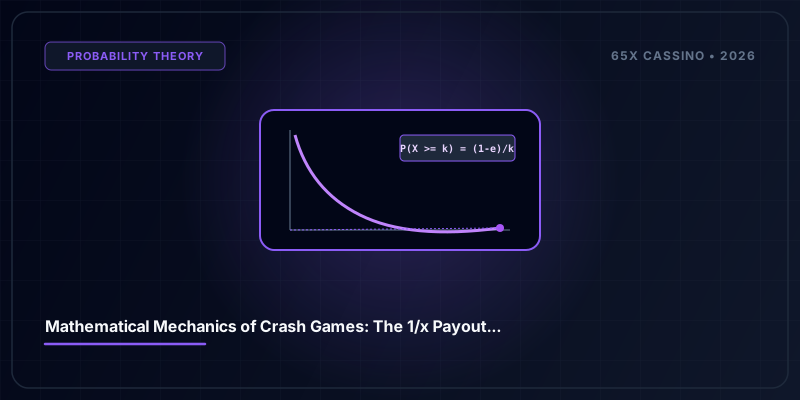
Let $X$ be the random variable representing the crash point multiplier. In a fair game with zero house edge, the probability that the multiplier reaches or exceeds any target threshold $k \ge 1.00$ must be inversely proportional to $k$: $$P(X \ge k) = \frac{1}{k}, \quad \forall k \ge 1.00$$ To guarantee an operator house edge $e \in (0, 1)$ (typically $e = 0.01$ for a $1%$ edge, or $e = 0.04$ for a $4%$ edge), the distribution is scaled by $(1 - e)$: $$P(X \ge k) = \frac{1 - e}{k}, \quad \forall k \ge 1.00$$
Cumulative Distribution Function (CDF)
The probability that the game crashes before reaching multiplier $k$ is given by the complementary cumulative distribution: $$F(k) = P(X < k) = 1 - P(X \ge k) = 1 - \frac{1 - e}{k}$$
Notice the immediate consequence at $k = 1.00$: $$F(1.00) = P(X < 1.00) = 1 - (1 - e) = e$$ This proves that the probability of an instant crash at exactly $1.00\times$ is equal to the house edge $e$. If the house edge is $3%$, exactly $3%$ of all rounds crash instantaneously before any player can click the cashout button.
The House Edge Invariance Proof
Let a player adopt a fixed cashout strategy $k > 1.00$ with a unit bet of $1.00$.
The payout random variable $W_k$ has two possible outcomes:
- Success ($X \ge k$): The player cashes out successfully, receiving payout $k$. (Net profit: $+ (k - 1)$).
- Failure ($X < k$): The multiplier crashes before $k$. (Net profit: $- 1.00$).
The expected return $E(W_k)$ is calculated by summing the products of outcomes and their respective probabilities: $$E(W_k) = k \cdot P(X \ge k) + 0 \cdot P(X < k)$$ Substitute the defined probability formula $P(X \ge k) = \frac{1 - e}{k}$: $$E(W_k) = k \cdot \left( \frac{1 - e}{k} \right) = 1 - e$$ Conclusion: $$E(W_k) = 1 - e, \quad \forall k \ge 1.00$$
The expected return is completely independent of $k$.
- A player cashing out at $k = 1.10\times$ achieves an expected return of $1 - e$.
- A player cashing out at $k = 2.00\times$ achieves an expected return of $1 - e$.
- A player cashing out at $k = 500.00\times$ achieves an expected return of $1 - e$.
Multiplier Probability Distribution Table (1% House Edge)
The table below illustrates the exact statistical probabilities and win frequency intervals for common multiplier targets under an active $1.0%$ house edge ($e = 0.01$):
| Cashout Target ($k$) | Probability $P(X \ge k)$ | Odds of Success | Expected Round Duration | Win Rate % |
|---|---|---|---|---|
| 1.00x (Instant Bust) | $0.0100$ ($1.00%$) | 1 in 100 rounds | 0.00 seconds | Immediate loss |
| 1.10x | $0.9000$ ($90.00%$) | 9 in 10 rounds | 1.20 seconds | $90.00%$ |
| 1.50x | $0.6600$ ($66.00%$) | 2 in 3 rounds | 3.50 seconds | $66.00%$ |
| 2.00x | $0.4950$ ($49.50%$) | 1 in 2.02 rounds | 6.20 seconds | $49.50%$ |
| 5.00x | $0.1980$ ($19.80%$) | 1 in 5.05 rounds | 14.80 seconds | $19.80%$ |
| 10.00x | $0.0990$ ($9.90%$) | 1 in 10.10 rounds | 22.40 seconds | $9.90%$ |
| 50.00x | $0.0198$ ($1.98%$) | 1 in 50.51 rounds | 38.60 seconds | $1.98%$ |
| 100.00x | $0.0099$ ($0.99%$) | 1 in 101.01 rounds | 46.20 seconds | $0.99%$ |
| 1,000.00x | $0.00099$ ($0.099%$) | 1 in 1,010 rounds | 68.00 seconds | $0.099%$ |
| 10,000.00x | $0.000099$ ($0.0099%$) | 1 in 10,101 rounds | 92.00 seconds | $0.0099%$ |
The Fallacy of Martingale in Crash Mechanics
Many automated scripts implement the Martingale betting progression: doubling the wager after every loss and cashing out at $2.00\times$. Proponents argue that a win at any point recovers all prior losses plus a one-unit profit.
However, in crash games, the Martingale strategy encounters two insurmountable mathematical realities:
- Table Limits: Every casino enforces a maximum bet cap (e.g., €500 or €1,000). Starting at €1.00, an 8-round losing streak requires a €256 bet, and a 10-round streak requires €1,024, exceeding the limit.
- Probability of Consecutive Losses: The probability of a single loss at $2.00\times$ is: $$P(\text{Loss}) = 1 - 0.495 = 0.505$$ The probability of losing 10 consecutive rounds is: $$P(\text{10 Losses in a Row}) = (0.505)^{10} \approx 0.00113 \quad (1 \text{ in } 885 \text{ sequences})$$ In a session of 5,000 rounds, an 8 to 11 round losing streak is virtually guaranteed by the law of large numbers, wiping out 100% of accumulated profits in a single catastrophic event.
Strategic Risk Management & Audit Checklist
When assessing or auditing crash multiplier dynamics, verify the following principles:
- Instant Crash Rate Audit: Analyze a 10,000-round sample. If the proportion of $1.00\times$ instant crashes deviates significantly from the advertised house edge (e.g., $4.2%$ observed on an advertised $1.0%$ edge), alert licensing compliance immediately.
- Dual-Bet Strategic Partitioning: If utilizing dual-bet mechanics (available in Aviator), evaluate both bets as independent wagers. Setting Bet A to auto-cashout at $1.50\times$ and Bet B to $5.00\times$ does not reduce the house edge on either position.
- Eliminate Reverse-Martingale Expectations: Recognize that letting profits ride during an upward multiplier streak increases portfolio variance exponentially without altering expected value.
- Verify Fixed Floating-Point Rounding: Audit that the game client truncates multipliers strictly downward to 2 decimal places rather than applying biased rounding.
- Audit Speed vs Friction: Remember that crash games execute rounds in $5 - 15$ seconds, dramatically accelerating the hourly velocity of capital turnover compared to traditional video slots.